“Nothing in life is to be feared, it is only to be understood. Now is the time to understand more, so that we may fear less.” — Marie Curie
Science explains the material world, from the cells that make up living things to the forces that shape the universe. A high-quality science education helps students understand the world around them, question it with curiosity and appreciate the wonder of the natural world. Through biology, chemistry and physics, students learn that diverse natural phenomena can be explained by powerful, connected ideas. They also develop the skills of working scientifically: asking questions, planning investigations, handling data and evaluating evidence. At Magnus Academy, key ideas are sequenced, revisited and deepened so students build secure knowledge over time. Practical work, scientific enquiry and mathematical skills sit at the heart of the curriculum, preparing students for further study, employment and informed engagement with the scientific questions shaping modern life.
Key information:
GCSE Specification
A Level Specification
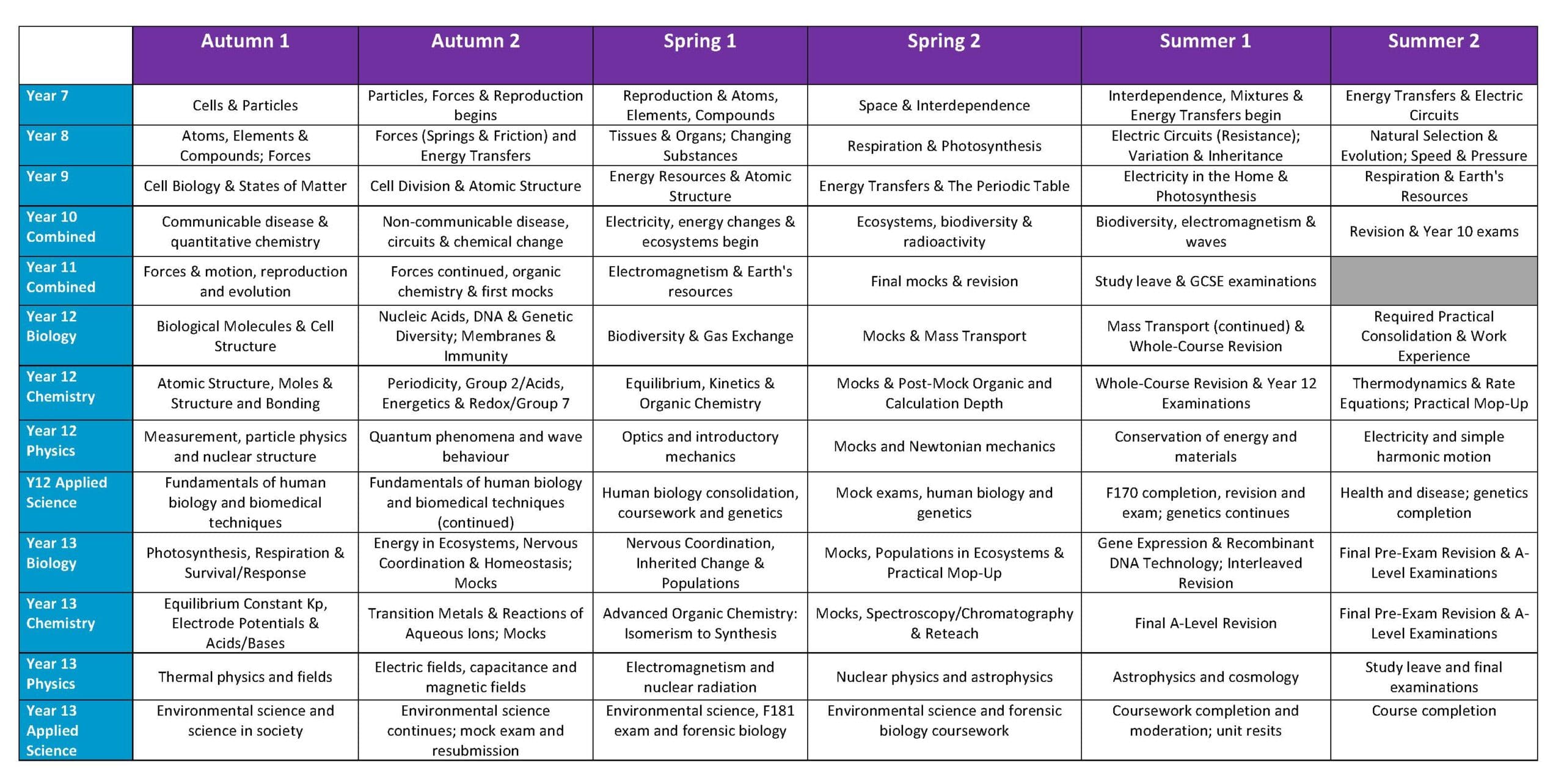
Curriculum Progression
Key Stage 3
At Key Stage 3, students build the foundations for science through biology, chemistry and physics. They develop secure knowledge of key scientific ideas and the disciplinary skills of working scientifically, including careful observation, accurate measurement, data presentation, analysis and evidence-based conclusions. The curriculum is deliberately sequenced so important ideas introduced early are revisited, connected and extended, preparing students for the pace and challenge of Key Stage 4.
Key Stage 4 (GCSE)
At Key Stage 4, the majority of students follow AQA GCSE Combined Science: Trilogy. This is a dual-award qualification, worth two GCSEs, covering all three sciences – biology, chemistry and physics. It is a linear course, meaning students sit all of their examinations at the end of Year 11. Students are entered for either the Foundation tier (grades 1–1 to 5–5) or the Higher tier (grades 4–4 to 9–9), with the tier of entry decided in the light of mock examinations and ongoing assessment. The course is taught across the three disciplines, with a strong emphasis on practical work and the application of scientific knowledge. Some students may instead be offered Triple Science, leading to individual GCSEs in biology, chemistry and physics.
Biology
Biology is the study of living organisms and how they interact with each other and their environment. Students study seven topics: cell biology; organisation; infection and response; bioenergetics; homeostasis and response; inheritance, variation and evolution; and ecology. They explore how organisms are organised from cells to whole systems, how the body defends itself against disease, how energy is transferred in living things, and how characteristics are inherited and species change over time.
Chemistry
Chemistry is the study of matter – what it is made of, how it behaves, and how it changes. Students study ten topics: atomic structure and the periodic table; bonding, structure and the properties of matter; quantitative chemistry; chemical changes; energy changes; the rate and extent of chemical change; organic chemistry; chemical analysis; the chemistry of the atmosphere; and using resources. They learn to explain the properties of substances in terms of structure and bonding, to carry out chemical calculations, and to relate chemistry to real-world issues such as climate change and the sustainable use of the Earth’s resources.
Physics
Physics is the study of energy, matter, forces and the fundamental laws that govern the universe. Students study seven topics: energy; electricity; the particle model of matter; atomic structure; forces; waves; and magnetism and electromagnetism. They learn to explain everyday phenomena and large-scale systems using a common set of principles, to work confidently with equations and units, and to connect physics to applications ranging from electrical circuits to radioactivity and the generation of electricity.
Key Stage 5 (A Level)
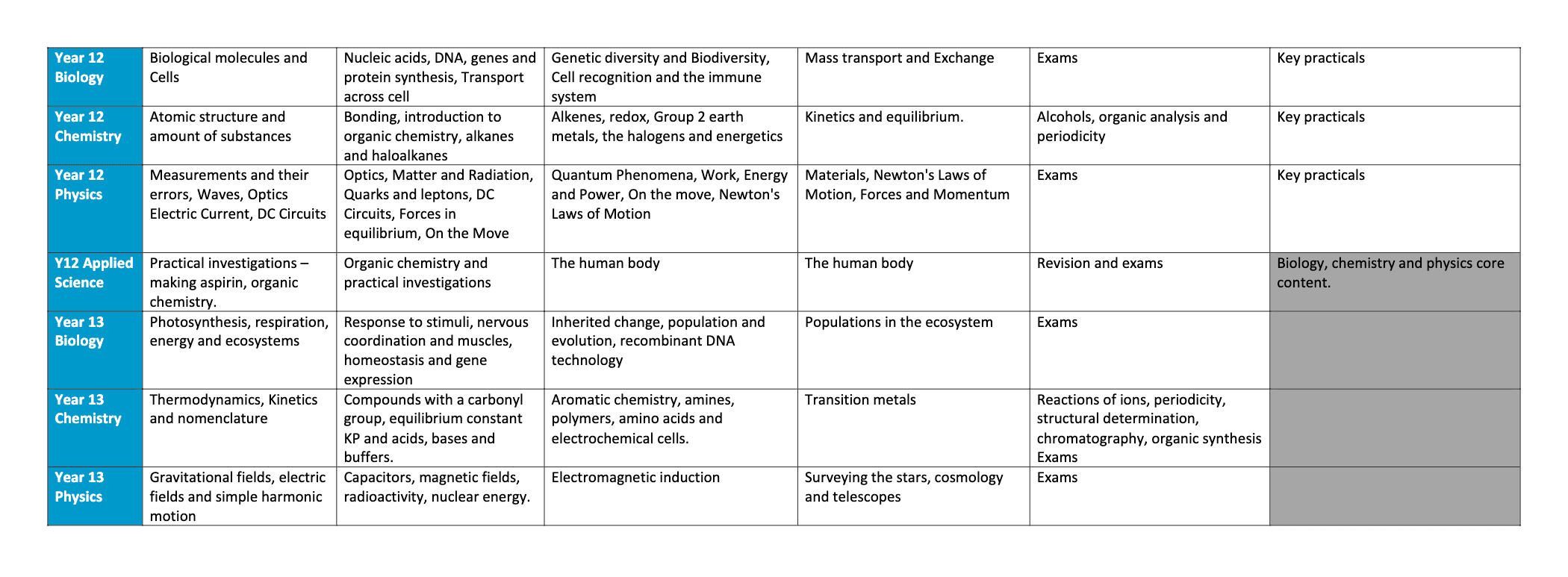
At Key Stage 5, students can progress from Combined Science to A Level biology, chemistry and physics, vocational or applied science qualifications and apprenticeships. Success at GCSE supports pathways in medicine and healthcare, engineering, technology, environmental science and many other fields. It also gives students the scientific literacy needed to understand evidence, evaluate claims and engage thoughtfully with the scientific issues they will meet throughout their lives.
Curriculum Map