“Pure mathematics is, in its way, the poetry of logical ideas” – Albert Einstein
The mathematics curriculum at Magnus promotes a problem solving mind-set and enhances resilience in the face of challenge; both invaluable skills necessary for later life. Class discussions and group work develop students’ critical thinking and allows them to acknowledge that multiple viewpoints can lead to the same correct outcome. In lessons, students have opportunities to master the skill of following a logical method to give an answer as well as having the space to creatively problem solve where there is not one correct answer. Aspects of mathematics will be used in every student’s future. For this reason, students learn about aspects of financial literacy and how mathematics is used within other subjects. The curriculum at Magnus is designed to expose students to a wide range of skills throughout their education, allowing all students to flourish and find the aspects they enjoy most.
Key information:
Exam Specifications
GCSE Specification
A Level Specification
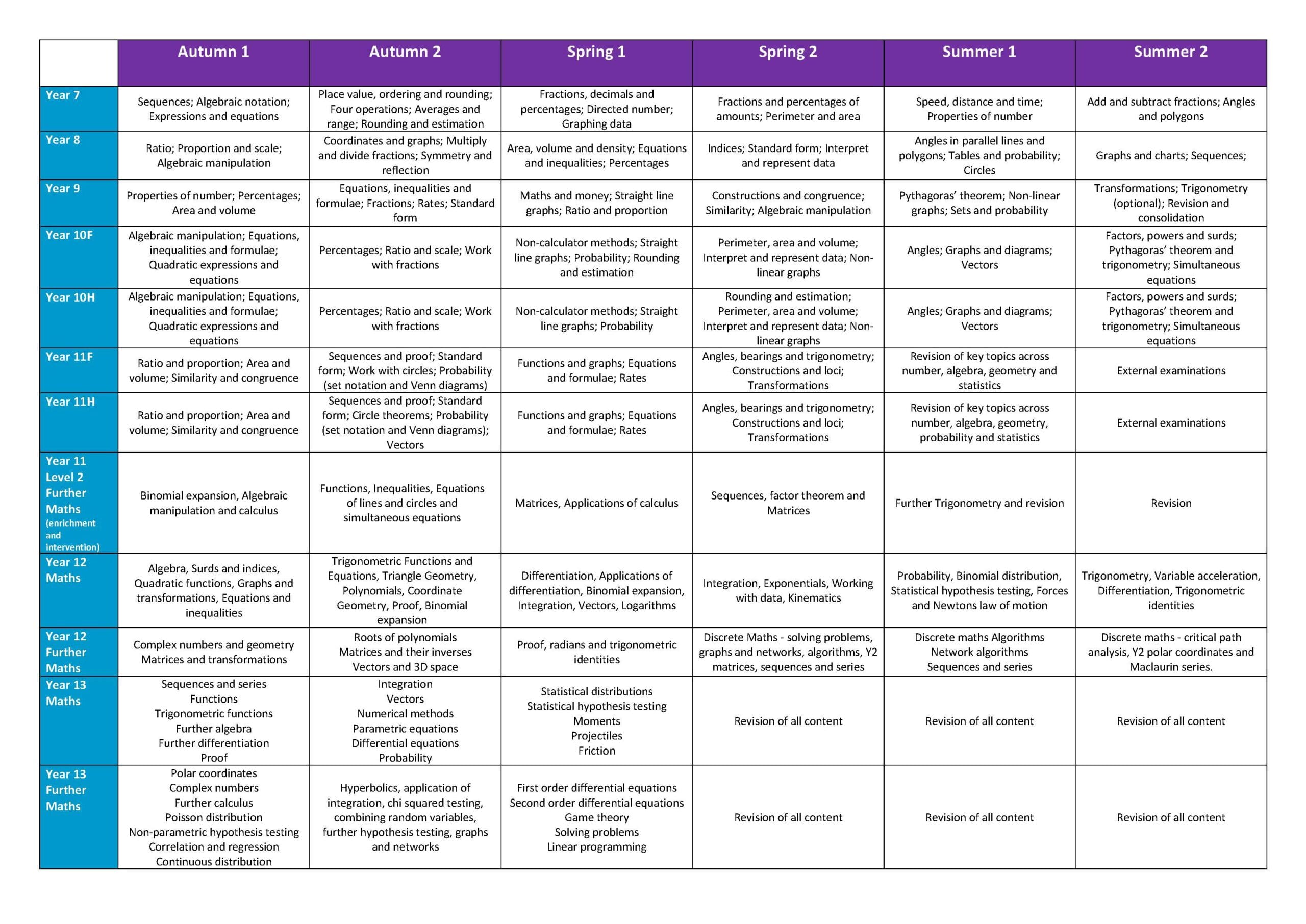
Curriculum Progression
Key Stage 3
At Key Stage 3, students develop the essential building blocks needed to succeed in mathematics through the White Rose Maths Scheme of Learning. This mastery approach ensures students secure a deep understanding of concepts before moving on. Students build a strong foundation in number and place value, including fluency with all types of number, alongside developing skills in algebra, geometry, and proportional reasoning.
The curriculum is carefully sequenced into small steps, allowing students to deepen understanding while making connections between topics. A strong emphasis is placed on reasoning, problem solving, and mathematical communication.
All students follow the same ambitious curriculum, with appropriate support and challenge to ensure accessibility for all. This inclusive approach ensures no student is limited as they progress to Key Stage 4, leaving with a secure and connected understanding of mathematics.
Key Stage 4 (GCSE)
At Key Stage 4, students build on their Key Stage 3 learning through the White Rose Maths Scheme of Learning, maintaining a mastery approach. The curriculum deepens understanding, strengthens connections between topics, and further develops fluency, reasoning, and problem-solving skills.
Students are entered for either Foundation or Higher tier GCSE, ensuring appropriate challenge and support. Lessons focus on developing key exam skills, including applying standard techniques, reasoning mathematically, and solving problems in a range of contexts. Students follow the Edexcel GCSE Mathematics specification, with regular exposure to exam-style questions and past papers to support exam readiness.
To support independent study and revision, students are encouraged to use resources such as 1st Class Maths, particularly the topic frequency lists, to focus their revision effectively.
GCSE Mathematics develops confidence, logical thinking, and a positive attitude towards maths, while providing a strong foundation for post-16 study.
Key Stage 5 (A Level)
At Key Stage 5, students have the opportunity to study two qualifications: A Level Mathematics and A Level Further Mathematics.
In A Level Mathematics, students follow a linear course comprising pure mathematics, statistics, and mechanics. They build on prior knowledge of algebra and trigonometry while developing understanding of new areas such as calculus. The course strengthens students’ problem-solving skills, mathematical reasoning, and ability to apply mathematics in a range of contexts.
A Level Further Mathematics offers students the chance to explore more advanced and challenging areas of the subject. Students study topics such as complex numbers, matrices, and further calculus in pure mathematics, alongside additional elements of statistics, mechanics, or discrete mathematics.
Together, these courses provide a rigorous and engaging pathway for students wishing to deepen their understanding of mathematics and prepare for further study or careers in mathematically related fields.
Curriculum Plan