“The study of geography is about more than just memorising places on a map. Its about understanding the complexity of our world appreciating the diversity of culture that exists across continents” – Barack Obama
Studying geography is important because it helps students understand the world around them and how people, places, and environments are connected. Geography teaches students about different countries, cultures, climates, and natural resources, helping them develop a wider understanding of global issues such as climate change, population growth, and sustainability. It also helps students build important skills, including map reading, research, problem-solving, and critical thinking. By studying geography, students learn how human activities affect the environment and how decisions made in one part of the world can influence other regions. Geography also encourages curiosity about different places and promotes respect for cultural diversity. These skills and knowledge are valuable in everyday life and can support careers in fields such as environmental science, urban planning, tourism, and international business. Overall, geography helps students become informed, responsible citizens who can better understand and contribute to an increasingly interconnected world.
Key information:
GCSE Specification
A Level Specification
Curriculum Progression
Key Stage 3
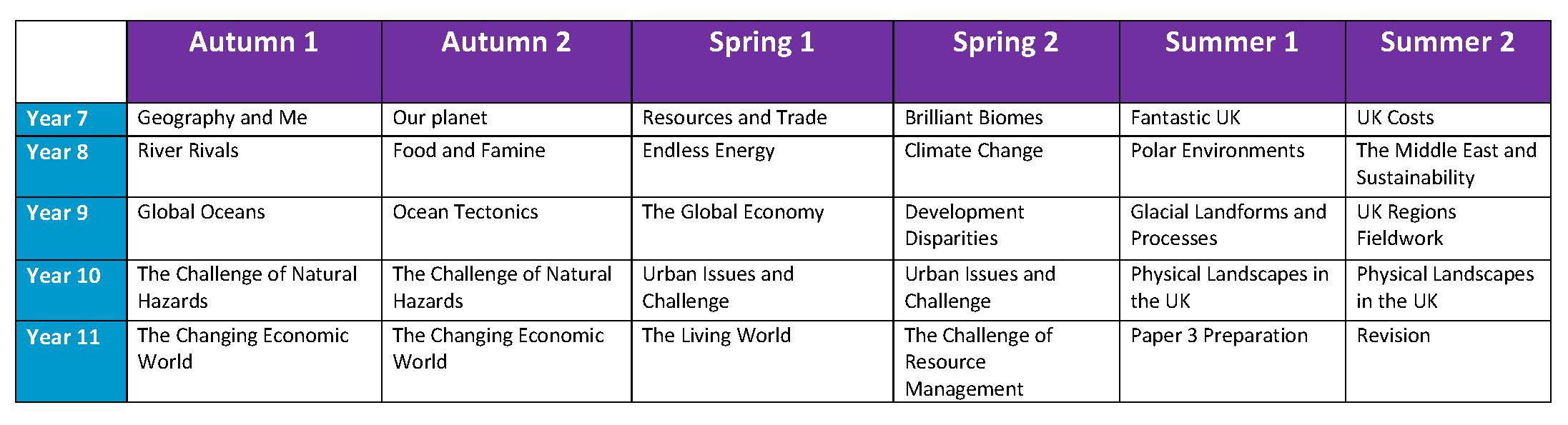
The Ark Geography Mastery curriculum is designed to help students develop a deep understanding of the relationships between people, places, and environments at local, national, and global scales. Students study a wide range of geographical topics, including physical landscapes, rivers, coasts, climate change, ecosystems, natural resources, trade, population, food security, energy, and global development. The curriculum uses diverse case studies from the UK and around the world to help students understand contemporary geographical issues and different perspectives. Alongside geographical knowledge, students develop key disciplinary skills that geographers use to investigate and explain the world. These include map reading, Ordnance Survey map skills, Geographical Information Systems (GIS), fieldwork techniques, data collection, analysis, interpretation, and decision-making. Students learn to ask geographical questions, evaluate evidence, identify patterns, and communicate well-reasoned conclusions. The curriculum also encourages curiosity, global awareness, environmental responsibility, and informed citizenship, helping students understand their place in an interconnected and rapidly changing world.
Key Stage 4 (GCSE)
The AQA GCSE Geography course helps students develop a strong understanding of both the physical and human world. Students study topics such as natural hazards, climate change, ecosystems, rivers, coasts, urbanisation, economic development, and resource management. They learn how people interact with the environment and how global issues affect different places around the world. The course uses a range of real-life case studies from the UK and other countries to help students apply their knowledge. Alongside geographical knowledge, students develop important skills including map reading, data interpretation, fieldwork investigation, graph analysis, decision-making, and evaluating evidence. They learn how to collect, present, and analyse information, as well as how to draw conclusions and justify opinions about geographical issues. Fieldwork is an important part of the course and helps students investigate real environments. Overall, AQA GCSE Geography prepares students for further study while developing valuable analytical and problem-solving skills for everyday life and future careers.
Key Stage 5
The AQA A-level Geography course builds on GCSE knowledge and develops a deeper understanding of the physical and human processes that shape our world. Students study topics such as water and carbon cycles, hazards, coasts, globalisation, changing places, urban environments, and resource management. They explore how people interact with natural environments and investigate contemporary issues including climate change, sustainability, inequality, and global governance. The course also requires students to complete an independent fieldwork investigation, where they collect and analyse their own data. Alongside geographical knowledge, students develop advanced skills in analysis, evaluation, research, and decision-making. They learn to interpret maps, graphs, statistics, and Geographical Information Systems (GIS), while also improving their ability to construct evidence-based arguments and extended essays. Fieldwork strengthens data collection and investigation skills, helping students apply geographical theories to real-world situations. Overall, A-level Geography prepares students for university study and careers in environmental management, planning, business, conservation, and many other sectors.
Curriculum Plan