“A child’s life is like a piece of paper on which every person leaves a mark.” – Robert Heinlein
Why is it important to study how children grow, learn and change? An understanding of child development is essential as it allows us to fully appreciate the cognitive, emotional, physical, social and educational growth that children go through from birth and into early adulthood.
Babies and young children are fascinating – why do they put everything in their mouths? Why do 2 year olds play alone but 3-4 year olds want friends? In this subject, you will look at child development patterns and how we decide what types of toys, resources and activities will be suitable and safe to put out. Knowledge of the patterns of child development helps us know how to support children at different ages; this is also needed to recognise when some children need additional support because they are not showing typical patterns of development.
The course also studies play which is a vital way to support children’s development. Early years settings plan a range of play opportunities and activities that will help children to learn; we look at the different ways play is structured and how early years settings use these. The course also looks at the principles of early years practice and how each child benefits from the opportunities on offer within early years settings and how children are supported.
At BTEC Level 3, we study a myriad of units all of which enhance a student’s ability to research; how we put theory into practice and students also complete work placement in a setting that supports children aged 0-8 years.
Key information:
Specification Level 1/2 BTEC
Specification Level 3 BTEC
Curriculum Progression
Key Stage 4 (Level 1/2 Tech Award)
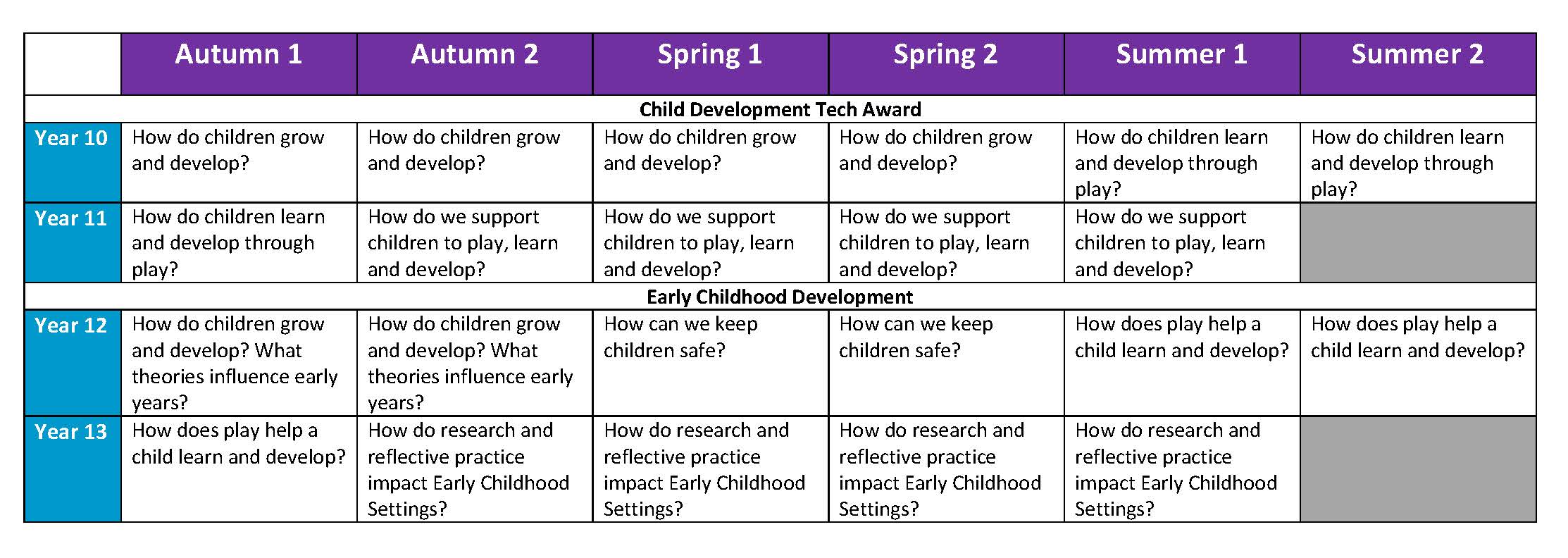
This is a course that students do not start until Year 10. They are introduced to the process of typical and atypical patterns of child development; play and learning and early years practice. Students have to take an external exam in the Patterns of Child Development and complete 7 assignments for their portfolio work, these assignments include how children play at different ages, how play is structured and how early years settings organise play opportunities. Students will also complete work on inclusive and non-inclusive practice, empowerment and key workers.
Key Stage 5 (Level 3 AAQ BTEC)
At Key Stage 5, students are introduced to a more in-depth study of children’s development and are offered opportunities to attend work placements. Students learn how children grow, learn and develop; how they gain numerous skills and abilities. Students can gain valuable insight by attending a work place setting as this helps them see theories including those of Piaget, Vygotsky, Bandura etc… in practice. Students will also learn how we keep children safe and look at current research and best practice in early years education.
Curriculum Plan